



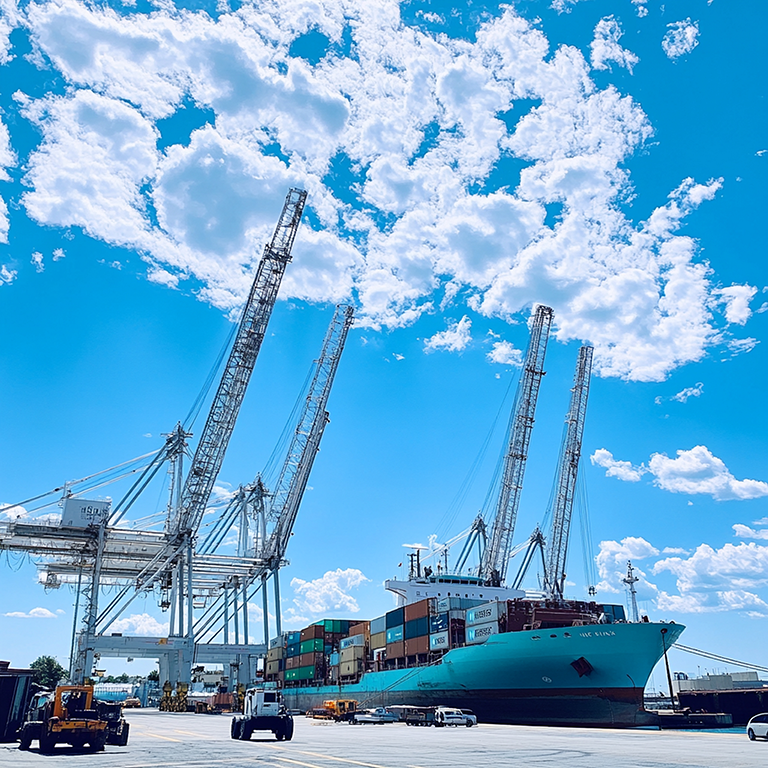
Container rates have risen for the second week running. Drewry’s World Container Index rose again, as higher rates on trans-Pacific routes more than offset the falls on the Asia–Europe route. Shipping lines are actively managing capacity in a market rife with disruptions.
Drewry’s benchmark WCI rose by 1 per cent per 40-foot container. At the same time, freight rate specialist Xeneta warns that nearly half a year of disruptions in the Middle East is now also having a significant impact on long-term contracts. For importers and exporters, this means that container rates will remain a key focus in the coming months.
Container rates on transpacific routes are soaring
The rise in the index was mainly driven by rates to the United States. The rate from Shanghai to New York jumped by 10 per cent per 40-foot container. The Shanghai–Los Angeles route rose by 6 per cent per container.
The trans-Pacific market is thus setting the tone for the global container shipping industry. Whilst many shippers had previously anticipated a cooling-off, rates to North America are, in fact, continuing to rise. The underlying cause lies not so much in extremely strong demand, but in the deliberate capacity management policies of shipping lines.
Further background on current market developments and rate movements can be found on the sea freight page.
Shipping lines are restricting capacity through blank sailings
Shipping lines are deliberately keeping the market tight by cancelling sailings. Ten sailings were cancelled in each of the past two weeks, and a further seven blank sailings are scheduled for next week. In doing so, carriers are actively managing the balance between supply and demand.
Drewry expects that the tighter capacity will keep container rates less volatile in the coming week. For shippers, this also means an increased risk of delayed shipments and fuller vessels. Anyone needing space would be wise to book early.
Blank sailings have become a tried-and-tested tool. Rather than lowering rates when demand falls, shipping lines are withdrawing capacity from the market. This artificially maintains price levels and strengthens their negotiating position.
Asia–Europe routes, however, are showing a decline
The picture was weaker on the route between Asia and Europe. The rate from Shanghai to Genoa fell by 8 per cent per 40-foot container. The Shanghai–Rotterdam route saw a 5 per cent drop per container.
Shipping lines have announced new FAK rates for the Asia–Mediterranean routes, effective from 15 August. According to Drewry, however, it remains to be seen whether these levels are sustainable now that demand is weakening.
For Dutch importers, the fall in rates on the route to Rotterdam is, at first glance, good news. Nevertheless, rates remain historically high and any announced increases could quickly turn the situation on its head. Read more about sea freight and importing.
Disruptions continue to grip the market
The wider east-west market remains disrupted by a series of disruptions. Security concerns surrounding the Suez Canal and the Strait of Hormuz are forcing shipping lines to take longer routes. In addition, restrictions remain in place in the Panama Canal.
Closer to the cargo, too, things are not running smoothly. Asian ports are struggling with congestion following the passage of Typhoon Dolphin, whilst inland transport in Europe is being hampered by record-low water levels on the Rhine. Every link in the chain is therefore feeling the pressure.
For shippers, this means that transit times are less predictable and that surcharges may be introduced more quickly. Good planning and timely coordination with the freight forwarder are therefore more important than ever.
Long-term contracts rise sharply due to the Middle East crisis
According to freight rate benchmarking firm Xeneta, nearly six months of disruptions in the Middle East are now spilling over into the long-term market. According to chief analyst Peter Sand, the impact of the conflict is increasingly evident in contract rates.
Since the end of February, long-term rates from the Far East to the US west coast and east coast have risen by 41 per cent and 40 per cent respectively. Contract rates to Northern Europe are also 41 per cent higher, whilst contracts to the Mediterranean have risen by 17 per cent.
These increases, however, still lag far behind the spot market. Xeneta calculates that spot rates from the Far East to the US West Coast are 271 per cent above pre-crisis levels. For the East Coast, the figure is as high as 287 per cent.
Spot market gives shipping lines a strong negotiating position
The growing gap between spot and contract rates is strengthening shipping lines’ position at the negotiating table. On the Far East–US West Coast route, the spot rate is now higher than the long-term rate, according to Xeneta.
Sand refers to the long-term financial fallout from supply chain shocks. He warns shippers not to be tied to one-year contracts in a rising market. His advice: opt for shorter agreements that secure capacity but leave room to adjust rates as soon as the spot market shifts.
For companies wishing to manage their logistics in a data-driven way, insight into rate trends and market data is becoming increasingly valuable. Those who also wish to improve their online visibility or enhance their processes with smart digital solutions, AI and marketing can turn to HEF Digital.
Implications for importers and exporters
For importers and exporters, these figures show that container rates can have a significant impact on cost price. The trans-Pacific market is rising, whilst Europe is cooling slightly; however, announced rate increases and ongoing disruptions are making the outlook uncertain.
This calls for thorough preparation. Request rates in good time, compare multiple routes and sailing options, and take into account surcharges and the validity period of quotations. Clear agreements on Incoterms, cut-off times and documentation also help to avoid surprises.
TOP is closely monitoring developments regarding container rates, capacity, blank sailings and shipping routes. For customers, it remains important to act promptly and tailor transport choices to costs, reliability and the desired transit time. Read more about requesting rates, Incoterms and container handling.
…a blank sailing means that a shipping line completely cancels a scheduled departure? With ten cancelled sailings per week, carriers are deliberately removing capacity from the market to keep container rates at a certain level.