



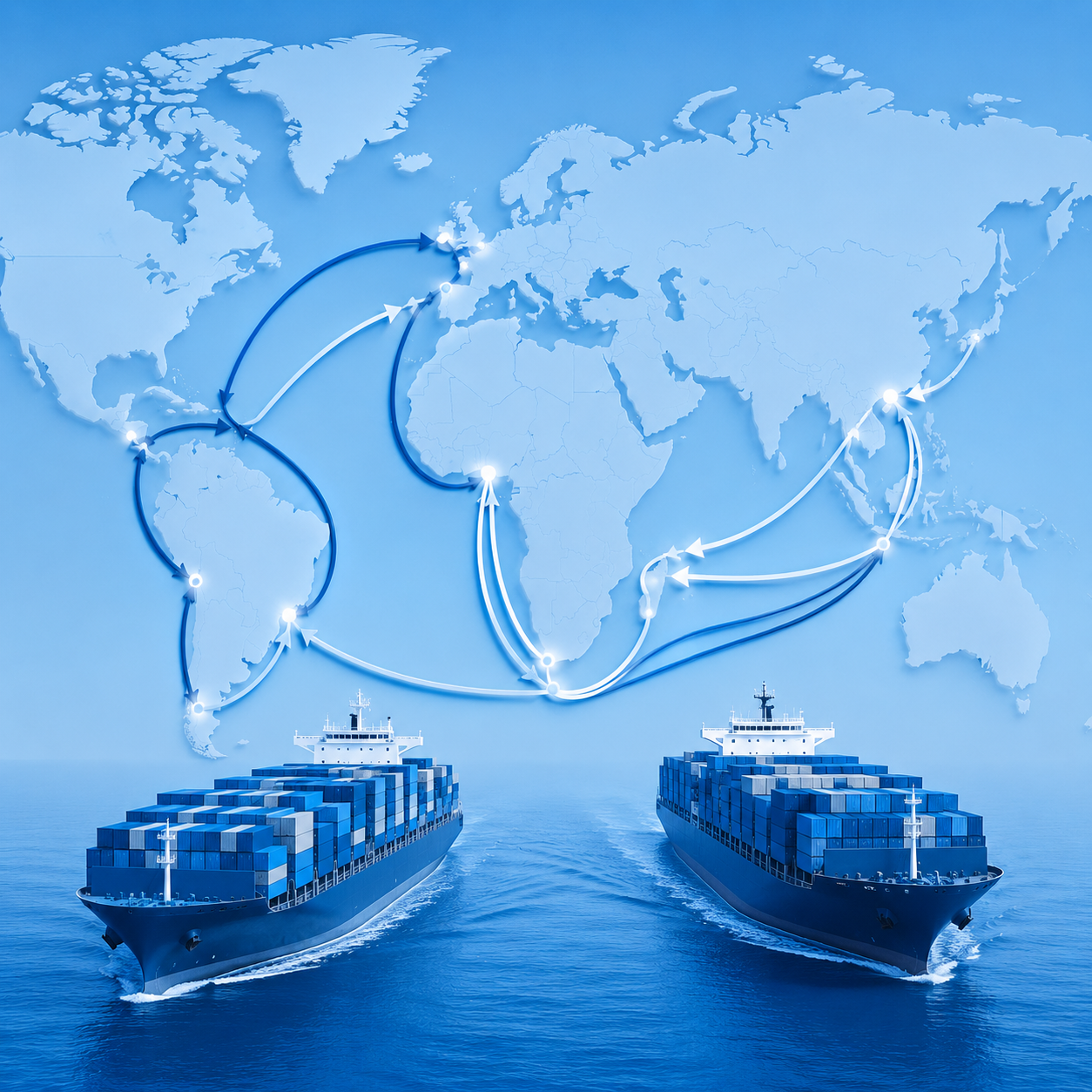
MSC and Maersk place a striking emphasis on north-south trade within their global network. The world’s two largest container shipping lines deploy a relatively large amount of capacity on services to Africa and Latin America.
This is evident from a new report by the French database Alphaliner, which quantifies the priorities of major container shipping lines based on the vessel capacity deployed per trading area. The report reveals a clear difference between European and Asian carriers.
MSC and Maersk opt for a broader operating area
For the global container shipping industry, the route between the Far East and Europe remains the most important trade lane. According to Alphaliner, around a quarter of all global container capacity is deployed between the Far East and Europe.
This route is the most important trade area for eight of the ten largest container shipping lines. Only ONE and ZIM allocate an even larger proportion of their capacity to the Transpacific route between Asia and North America.
MSC and Maersk deviate from this to some extent. Whilst both shipping lines deploy 28 per cent of their capacity between the Far East and Europe, they also devote significant capacity to services to Latin America and Africa. Further information on international container flows can be found on the sea freight page.
MSC and Maersk are focusing heavily on Latin America
For MSC, Latin America ranks second in terms of fleet capacity allocation. The shipping line deploys 17 per cent of its capacity on services to and from Latin America. For Maersk, that share is even slightly higher, at 18 per cent.
This sets MSC and Maersk apart from many Asian carriers, which rely more heavily on Asian export flows. For customers, this means that the availability of sailings, space and connections per region can vary significantly from one shipping line to another.
Latin America is attractive to container shipping lines due to growing trade flows, exports of raw materials, foodstuffs and industrial goods, and increasing demand for reliable connections with Europe and Asia. It therefore remains important for importers and exporters to consider not only price, but also frequency, transit time and network coverage.
Africa ranks in the top three for MSC and Maersk
According to Alphaliner, MSC and Maersk are also the only two carriers in the top 10 for which Africa features in the top three most important trading regions. MSC deploys 14 per cent of its fleet for services to and from Africa. For Maersk, the figure is 13 per cent.
This is in line with both shipping lines’ broader position in north-south trade. These routes connect Europe, Africa, Latin America and other regions outside the traditional east-west routes. Such connections are often more complex, as ports, terminals, feeder services and hinterland connections vary significantly from country to country.
For companies doing business with Africa, reliable planning is essential. Capacity, port congestion, customs processes and local documentation can have a significant impact on the total transit time. TOP supports customers with, amongst other things, exports, imports and customs.
Asian carriers focus more strongly on exports from Asia
For Asian carriers, the emphasis is much more pronounced on Asian exports. When the two major east-west routes – Far East–Europe and Transpacific – are added to intra-Asian traffic, a clear picture emerges.
According to Alphaliner, Yang Ming deploys 91 per cent of its fleet capacity on these Asia-related trade flows. For Evergreen and HMM, the figure is 78 per cent in each case. COSCO and ONE stand at 66 and 65 per cent respectively.
For European carriers, this percentage is significantly lower. According to Alphaliner, the share for all European carriers remains below 50 per cent. For MSC, it is as low as 37 per cent. This underlines just how broadly MSC and Maersk spread their global capacity.
HMM and ZIM heavily reliant on a single route
Alphaliner also notes that two top-10 shipping lines deploy more than half of their capacity on a single route. HMM has 53 per cent of its fleet sailing between the Far East and Europe. ZIM deploys 52 per cent of its capacity between Asia and North America.
Such a strong focus can offer advantages in terms of economies of scale and specialisation, but it also makes a shipping line more vulnerable to disruptions on that route. Examples include geopolitical tensions, port congestion, falling demand, rate pressure or diversions due to unrest on key shipping routes.
It is therefore important for shippers to understand shipping lines’ network strategies. The choice of a carrier is not just about the lowest rate, but also about reliability, route selection, capacity, frequency and the availability of alternative solutions.
North-south traffic is becoming strategically more important
MSC and Maersk’s focus on north-south traffic shows that container shipping lines are looking beyond the traditional main corridors between Asia, Europe and North America. Growth in Africa and Latin America is making these markets more important within global supply chains.
For logistics planners, this means that routes outside the traditional east-west corridors require greater attention. Capacity on these routes can shift more rapidly, particularly when shipping lines adapt their fleets to new market opportunities or geopolitical risks.
Companies operating internationally would be well advised to regularly review their transport infrastructure. This applies to sea freight, but also to combinations involving multimodal transport, air freight and supplementary customs services. A comprehensive route analysis helps to minimise risks and make better choices when it comes to international shipments.
…in container liner shipping, ‘north-south traffic’ refers to services between regions such as Europe, Africa, Latin America and Oceania? These routes are less dominant than the major east-west routes, but are becoming increasingly important for the global distribution of trade flows.