



Digital bills of lading will have the same rights
Bill of Lading will receive the same legal status as the paper version from 1 July. This officially places the electronic bill of lading on equal footing with the traditional document that has played a central role in ocean freight for decades.
This follows a publication in the Dutch Government Gazette. In a bill of lading, a carrier confirms, among other things, that certain goods have been received, will be transported and under which conditions. The Bill of Lading is therefore an essential document for shipping lines, freight forwarders, importers and exporters.
Bill of Lading becomes legally equivalent
In practice, the Bill of Lading has already been widely used in electronic form. However, uncertainty remained for a long time regarding the legal status of an electronic bill of lading. The fact that a digital document cannot be physically handed over by the carrier to the shipper highlighted the need for clear legislation.
That clarity has now arrived. A legislative proposal submitted by former State Secretary for Legal Protection Teun Struycken and Minister of Infrastructure and Water Management Barry Madlener was adopted on 1 April. As a result, the digital document now has the same legal standing as the paper original.
Bill of Lading speeds up document processing
According to the Royal Association of Dutch Shipowners (KVNR), the introduction of the electronic bill of lading is important for the logistics chain. Digital documents can be processed more quickly, reduce administrative burdens and contribute to a safer and more efficient handling of cargo flows.
For the ocean freight sector, this is an important step forward. Documents often determine whether cargo can be released, transferred or transported further. When those documents have the same legal force in digital form, delays caused by paper processes can be reduced.
More information about this document can be found on the page about Bill of Lading and on international transport solutions via the ocean freight page.
Bill of Lading fits logistics digitalisation
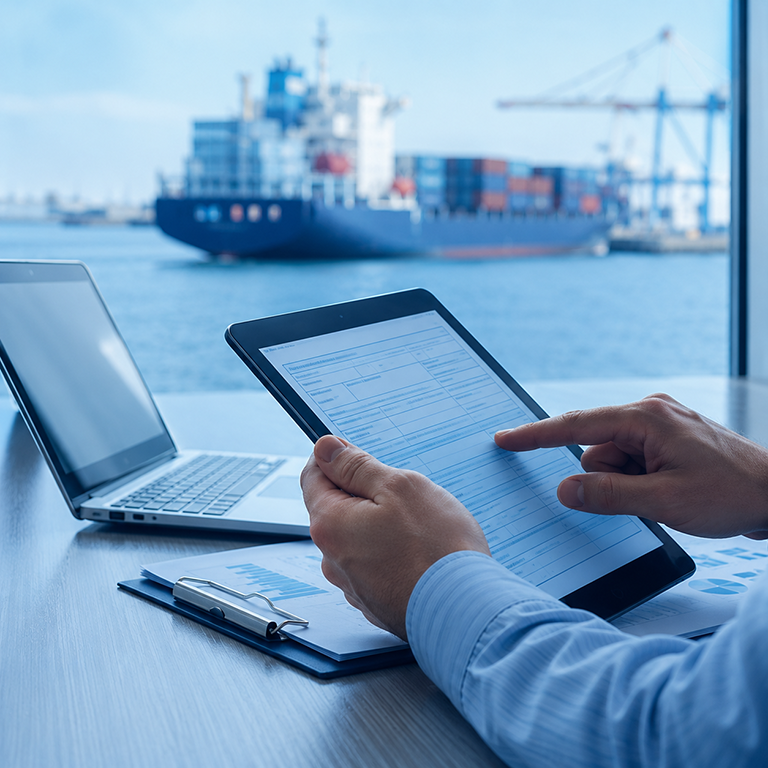
The equalisation of the digital Bill of Lading fits within a broader development in which logistics documents are increasingly processed digitally. This makes processes less dependent on physical transfers, postal services, couriers and manual checks.
For companies, this means greater speed, improved control and a lower risk of documents being lost. Especially in international supply chains involving multiple parties, digital document processing can save significant amounts of time.
...a Bill of Lading can simultaneously serve as a receipt, a contract of carriage and a document of title? This is why its legal status is so important in ocean freight.
Would you like to receive our newsletter?
Stay informed about developments in ocean freight, customs, logistics and international trade. Sign up now: