




TOP MAGAZINE · In the media
Onze Haven spoke to Jean Paul van Munster, owner of Trans Ocean Pacific Forwarding. A candid account of how TOP started out in 1992 with just three people at the Waalhaven, of the years spent with a listed shareholder, and why TOP is now standing on its own two feet again. And of what boxing and entrepreneurship have in common. With the permission of Onze Haven, we are sharing the full interview here.
From an eighteen-year-old intern who secretly took a peek at the executive floor to the owner of a multi-million-euro company that he later bought back: Jean Paul van Munster steered Trans-Ocean Pacific (TOP) through storms, fax chaos and stock market adventures. A portrait of a true Rotterdammer who does business on instinct during the week and fights twelve rounds in the ring on Saturday mornings.
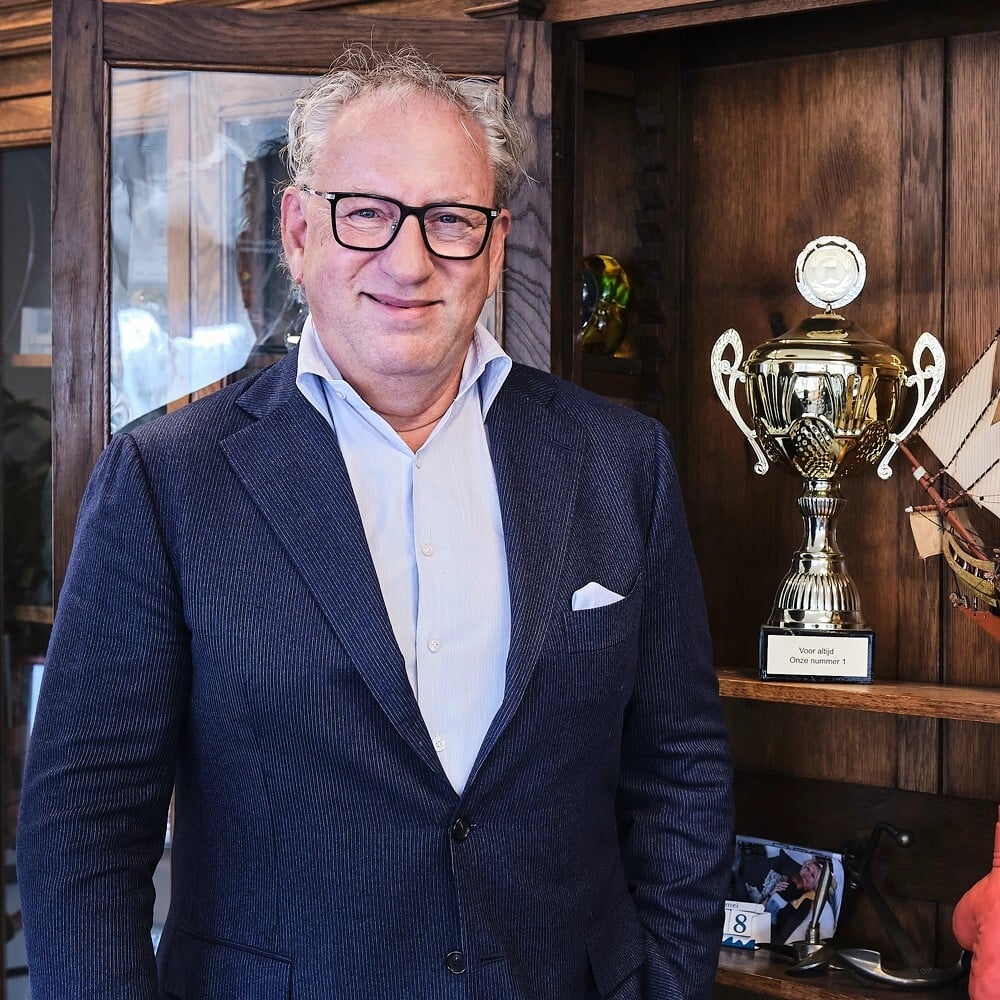
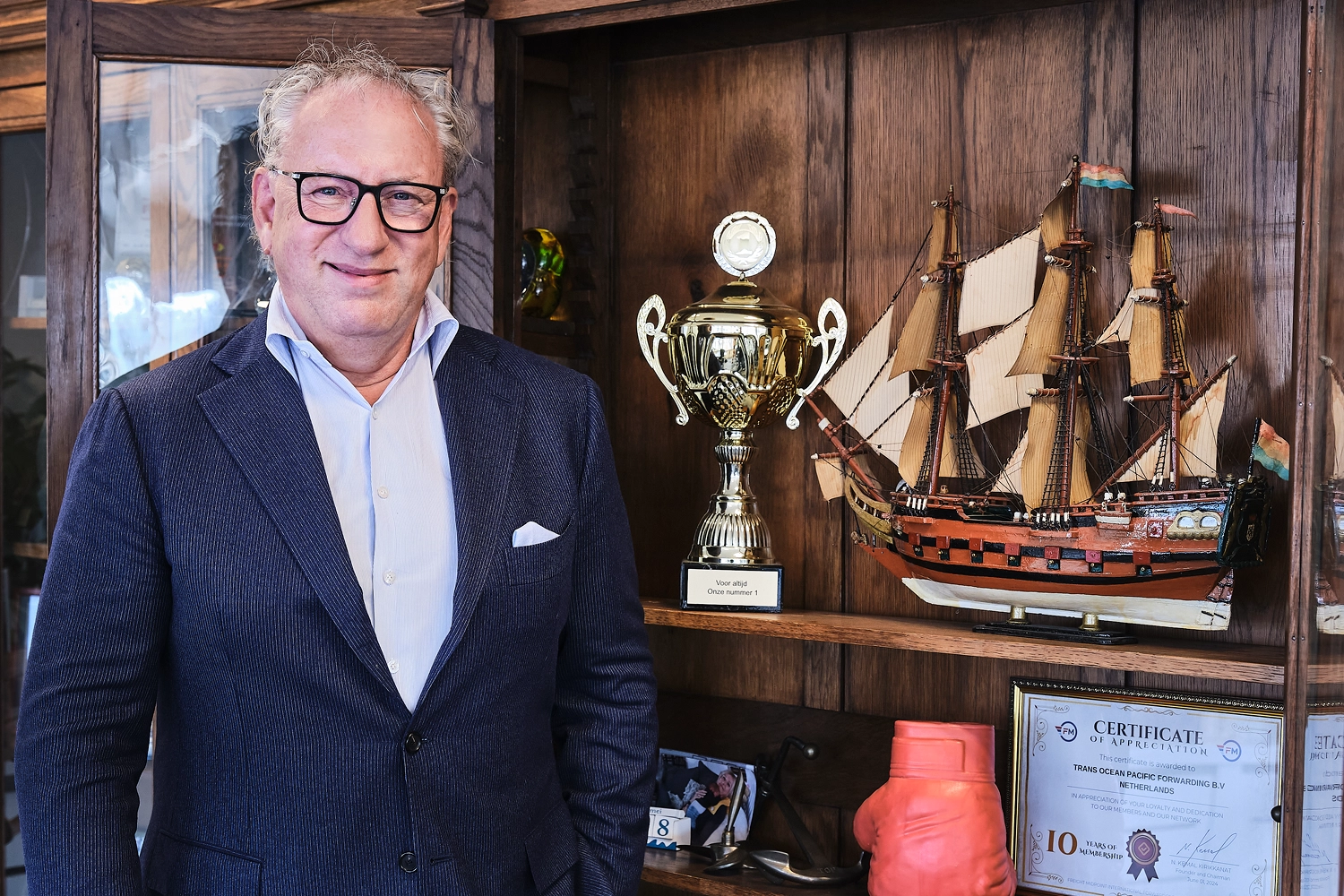
In the sleek open-plan office at TOP on the Waalhaven, everything exudes a sense of contemporary bustle. Glass walls, people behind screens. Until, at the back, you spot an executive’s office that seems to belong to another era. A dark apothecary’s cabinet full of trophies and mementoes, a sturdy wooden desk with a brass lamp, an antique telescope trained on the harbour. On the wall: historic seagoing vessels. Behind the desk sits Jean Paul van Munster, who stands up to greet you like an old friend.
“I was just eighteen when I joined D. Burger & Zoon – now Koninklijke Burger – as an intern,” says Van Munster. “The management were based on the first floor. As an intern, you weren’t really supposed to go up there.” Until one day he found himself there after all, in the stately office of the managing director and owner, Mr Aalders. “I thought to myself: right, so this is what the office of a port company director looks like.”
Years later, Van Munster came across a bankrupt furniture shop and knew straight away what he wanted. “That desk, the table we’re sitting at now, that telescope – it’s all from there.” The apothecary cabinet came from his wife’s grandmother. “What on earth are we going to do with that cabinet, we thought. It’s got a bit of sentimental value, after all.” One practical alteration: “We had to saw off the bottom bit because it was too high.”
Chicken and chips
His love for the harbour began with his father. Van Munster was six when he used to go down to the quay on Saturdays and during school holidays. His father worked for Oudkerk, which at the time specialised in deep-sea shipping with large ore carriers, and for Heerema, with workboats for the offshore industry.
“Back then, you’d just take your six-year-old son to the harbour, down to the quay, and on board.” Around two hundred men worked on a ship like that, and he was spoilt rotten in the galley. “Chicken and chips – I’ll never forget that.” He laughs. “I thought: well, that’s what I’m going to do too. When I grow up, all I want to eat for lunch is chicken and chips.” What began as a boy’s dream about chips turned into a serious ambition: he wanted to become a freight forwarder, just like his father. “That always outlasted all my ambitions to be a policeman, a pilot or a firefighter.” Through the Jan Backx Port and Transport School, he found his way into the trade, first as an intern at Oudkerk, and later moving into freight forwarding via shipping agency offices. It was a conscious choice: “A shipping agent really only has one client: the shipping line. The freight forwarder is closer to the shippers or consignees.”
Trans Ocean Pacific on the North Sea
At Richard Kempers B.V., Van Munster represented a Taiwanese freight forwarder: Trans Ocean Pacific Forwarding, operating between the Far East and America. A rather odd name for an office on the North Sea, certainly, but the client wanted to enter the European market. Richard Kempers didn’t see any profit in it. Van Munster did. “So I said: right, then I’ll just do it myself.”
1992, aged twenty-five, running his own business. Two years later, the Taiwanese shareholder went bankrupt, having burnt out on an overly ambitious shipping venture. Van Munster bought back the shares and, with just three people in the office, suddenly found himself on his own. Incidentally, those same three are still working at TOP. One of them, Saskia de Jong, became his business partner. She is now COO of FPS, a sister company of TOP, and together they form the management board of RHH (Rotterdam Harbour Holding B.V.).
The years that followed were a real struggle. “Try to work a bit harder than the others, go the extra mile,” says Van Munster when asked how he went about things. Everything was done by fax: a note in WordPerfect 5.1, print it out, walk over to the machine. At the weekend, he did the admin with his colleague Linda, who still works at the company. “She’d come in to work on Saturdays too. Then on Sundays, we’d just tidy up the last bits and pieces. Then you were ready for the new week.” For ten years.
The fax keeps cropping up in Van Munster’s story. It symbolises a time when the world moved at a slower pace, but the work was no less demanding. “The absolute worst: when you were travelling and came back to your hotel room in the evening to find a fax slipped under the door. That never meant anything good.” Phoning from a hotel was expensive, so he would write his reply by hand and ask reception to fax it back. Trips to the Far East used to take two or three weeks. “Now there are annual Agency Meetings and you’re back home in five days. Gosh, I’ve travelled so much and I always really enjoyed it. I think my people should get to experience that too.”
Singapore and Alibaba
The most striking chapter in TOP’s story begins in 2015, when Singapore Post came knocking. Van Munster knows the city well, both professionally and personally. He even proposed to his wife there. Singapore Post wanted to expand into logistics and had bought offices that were already working with TOP. The missing link was RHH.
Van Munster turned down the first offer. From Singapore, he rang his finance director, Evert, to tell him the news. “I thought it was quite a thrill to ring Evert from Singapore to tell him I’d turned down a multi-million deal,” he says with a grin. Six months later, Singapore Post came back, asking him to set out in writing the conditions under which he would agree to the deal. He demanded a say in the business, control and a guarantee that all sea freight from Alibaba – at the time a shareholder in Singapore Post – would go through him.
It all seemed too good to be true, he thought as he sent it back. The reply came during the Intermodal trade fair in São Paulo, where he was rushing from meeting to meeting with Saskia de Jong. His finance director, Evert, rang – and he never rings just for a chat. ‘They’ve agreed to everything, Jean-Paul!’ That evening, they had their first meal together without any clients or agents. “It was quite an emotional evening. We knew this would change a lot in our lives.”
Singapore Post had been a shareholder for ten years. Financially sound, but without the much-hoped-for boost. The CEO behind the plan was sacked four months later, and with that, everything Van Munster had signed up for vanished. “Every month we’d send off our results. And then the reply would come: thank you. Nothing else.” Last year, Singapore Post asked RHH if it would buy back the shares. “It’s rather odd, of course, when you’re in your fifties and you get such a major shareholder on board and think: my pension is sorted. And then, when you’re sixty, you transfer the money back to buy back your own shares.”
Still, they did it with love. “Saskia and I love this company.” Since then, RHH has been standing on its own two feet again with TOP and FPS, and it feels like things are moving faster. This year, the company bought an office in Bremen, a decision that, had it been a listed parent company, would first have had to go through a quarterly meeting. “By then, the opportunity would have been missed. Now, a glance between Saskia and me is enough. Evert sometimes says: ‘I don’t know if this is a clever idea’.” Laughing: “And then we do it anyway. We know he’s right, but that just makes us work even harder at it.”
The gloves under the Christmas tree
If you look closely in the display cabinet with the trophies, you’ll spot something unexpected amongst the model ships and certificates: a red boxing glove with a plaque reading: ‘Forever, our
number 1.’
Van Munster boxes. Seriously. “I’m in the ring for twelve rounds every Saturday.” It all began in 2015, when his friend Jan Overdevest, a terminal director, took part in ‘Gladiators on the Maas’, a charity boxing evening for businesspeople. Van Munster watched him win three two-minute rounds. When Overdevest slumped down at the table, completely knackered, afterwards, he asked: ‘Are you ill or something? You’ve only been moving for six minutes – you shouldn’t look like that, should you?’ Overdevest retorted: ‘You should try it yourself.’
Four years later, his wife’s answer lay under the Christmas tree: a pair of boxing gloves with a trainer’s address on them. He started in January 2020. Just before the Covid lockdowns, he converted a children’s bedroom into a training room. “Training every evening – outdoors in the summer, indoors wearing a face mask.” In 2022, he stepped into the ring for the first time against an opponent twenty centimetres taller than him. He lost on points, but the fire had been lit. Last year, he organised a Peaky Blinders-style boxing tournament at the RDM dry docks.
What appeals to him about the sport goes beyond the physical. “You train your fitness, technique, speed and reflexes.” But it’s that first year of training in particular that fascinates him: just defending, blocking and footwork. Only once the foundations are in place are you allowed to throw punches. It’s actually just like entrepreneurship, isn’t it? Training hard without immediate results, persevering when things go against you, taking risks and being able to take a knock. Then being ready for the next round.
Back in the glass-fronted office
Back to that office, with the telescope overlooking the harbour and the display cabinet full of thirty-five years of TOP. Van Munster is now sixty, a grandfather of three, and said two years ago that he would carry on for another five years. “So, by that reckoning, my time is almost up.” He laughs about it. He’s not setting any more milestones. “You never know how life will turn out.”
What does he do know? “If you turn your hobby into your job, you’ll never have to work again.
And this” – he gestures around him – “is also my hobby.”
This interview previously appeared in *Onze Haven*.
Text: Karin Koolen.
Photo: Vincent van Dordrecht.
With thanks to Onze Haven for their permission.
Personal contact, short lines of communication
Your dedicated contact person will handle your shipment from start to finish. See for yourself how TOP works.