




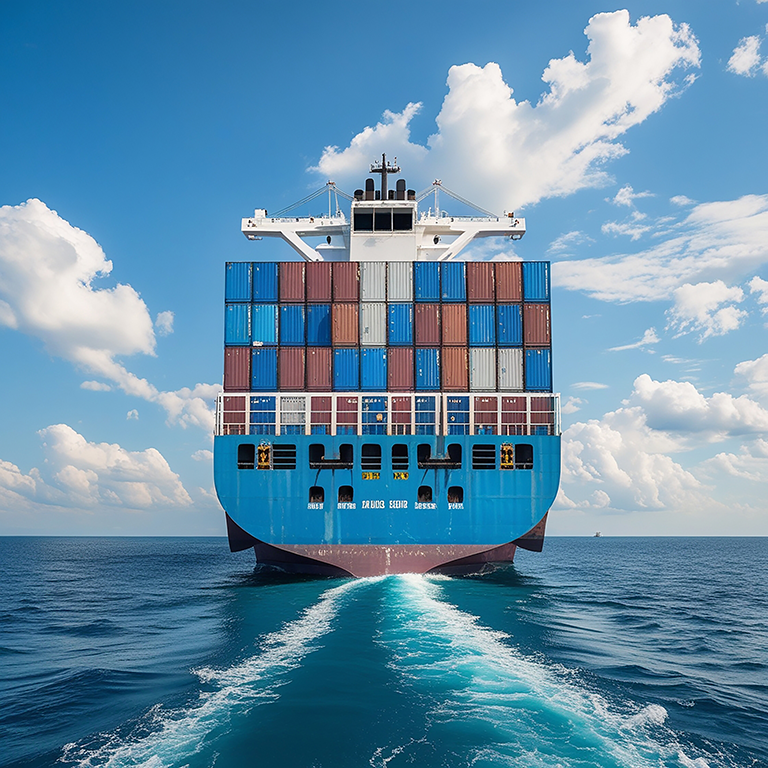
Maersk introduces emergency rates of up to $4,800 for Gulf routes
Maersk charges an Emergency Freight Rate for container shipments to and from ports in the Persian Gulf. The rate ranges from 1,800 to 3,800 dollars per container; if a ship actually sails through the Strait of Hormuz, an additional 1,000 dollars per container is added. This is evident from the shipping line’s Middle East Operational Update and from reports in the trade publication Container News.
The key figures: $1,800 for a 20-foot dry cargo container, $3,000 for a 40-foot dry cargo container, and $3,800 for reefer containers, special-purpose containers and containers carrying dangerous goods. On 11 September, Container News estimated that the additional costs for some shipments could therefore amount to up to $4,800 per container. In Operational Update 47 of 16 September, the amounts are listed as unchanged.
Which ports are subject to the emergency tariff?
According to Maersk, the surcharge applies to cargo loaded at or destined for ports in Iraq, Kuwait, Bahrain, Qatar and the United Arab Emirates. The Saudi ports of Dammam and Jubail are also included, as is Oman, with the exception of Salalah. The amount depends on the container type and, according to the shipping company, its introduction is subject to the required approval by the regulatory authorities.
What does the surcharge cover?
Maersk states that the emergency tariff is necessary to arrange alternative routes to the final destination, including temporary storage and the deployment of additional chartered vessels. Transport from the temporary storage location to the final destination, as soon as it is safe to do so, is included. The rate includes 14 days’ storage en route; after that, the shipping line charges $25 per TEU per day, with additional costs for monitoring and power supply for reefer containers.
According to Maersk, the additional $1,000 for vessels passing through the Strait of Hormuz covers, amongst other things, higher insurance premiums and risk allowances for the crew. This amount replaces the costs that the shipping line currently charges separately for the land bridge solution. Maersk reserves the right to adjust the emergency surcharge in view of the rapidly changing situation.
Three options for cargo currently in transit
For existing bookings and cargo in transit, Maersk offers three options. Option A is to complete the planned voyage with temporary storage at a port chosen by Maersk, at the emergency rate. Option B is to return to the port of origin, and Option C is a change of destination (COD). For options B and C, the shipper pays the standard COD charges plus the difference in freight costs, and both are subject to operational feasibility.
The timing of the decision matters. If the decision is made before the container reaches the affected region, the emergency rate does not apply. Anyone who makes a choice after the container has arrived in the region, or within 72 hours of the scheduled unloading, will have to pay it. Maersk also reserves the right to terminate the carriage; in that case, any costs already invoiced or paid will not be waived or refunded.
Rerouting via Salalah and Khor Fakkan
Cargo destined for Kuwait, Iraq, Qatar, Bahrain and the Emirates is transhipped in Salalah and Khor Fakkan. From there, it is transported by land bridge – i.e. by road – to Sharjah and then via Maersk’s feeder network within the Gulf to its final destination. Saudi import and export cargo continues to be routed via Jeddah, including for destinations such as Riyadh and Dammam.
Update 47 adds that some of the shipments with Khor Fakkan as their final destination are unloaded in Fujairah and transported overland to Jebel Ali under customs supervision. The port of destination for these shipments is changed to Jebel Ali. According to the shipping line, affected customers will be informed individually; any additional costs for transport, customs clearance and storage are covered by Maersk’s terms and conditions of carriage.
Booking suspensions remain in force
In addition to the rates, Maersk is maintaining a series of booking restrictions. For dry cargo, bookings have been suspended to and from the Emirates (with the exception of Khor Fakkan and Jebel Ali), Iraq and the Saudi ports of Dammam and Jubail. Destinations that are accepted include Jeddah, King Abdullah Port, Kuwait, Qatar, Bahrain, Salalah and Sohar.
For reefers, dangerous goods and out-of-gauge cargo, the restrictions are less stringent, according to Container News. Maersk says it is paying particular attention to shipments of critical foodstuffs, medicines and perishable goods.
Empty containers and yet another surcharge
Container logistics have also been disrupted. For import shipments to the UAE, Qatar, Bahrain, Kuwait, Jubail, Iraq and Duqm in Oman, Maersk is temporarily not accepting empty containers at the usual locations. Designated depots are Salalah and Jeddah. Elsewhere, acceptance is limited and subject to a drop-off surcharge: in Jebel Ali, for example, this is US$1,000 for a 20-foot container and US$1,200 for a 40-foot container.
In Update 47, Maersk also announces an Emergency Operational Cost Recovery Surcharge for contract bookings to the Emirates from all regions of origin except the Far East, and a similar surcharge for Bahrain, Qatar, Kuwait and Iraq. The amounts and effective dates are set out in separate notices from the shipping line. Maersk also points out that various insurers have limited or withdrawn cover for shipments to the Red Sea, the Gulf of Oman and the Persian Gulf.
Implications for importers and exporters
So much for the facts; what follows is TOP’s analysis. The emergency tariff is in addition to the base rate and existing surcharges, meaning that the total price of a Gulf shipment may differ significantly from a previous calculation. You should therefore check whether current bookings are covered by the rate and, for new shipments, request a quotation in good time that specifies all surcharges. Who bears the additional costs depends on the agreed Incoterms.
Now that insurers are restricting cover for the region, it is advisable to review your transport insurance policy. For cargo that is already in transit, the decision point between Maersk’s three options determines whether the emergency rate is payable. TOP can carry out a cost impact calculation for each route; please ask for advice on this.
Did you know that…
…Maersk’s emergency rate includes 14 days’ storage en route? From day 15 after unloading at the port of storage, the shipping line charges 25 dollars per TEU per day. A TEU is the standard unit for one 20-foot container; a 40-foot container counts as two TEUs.