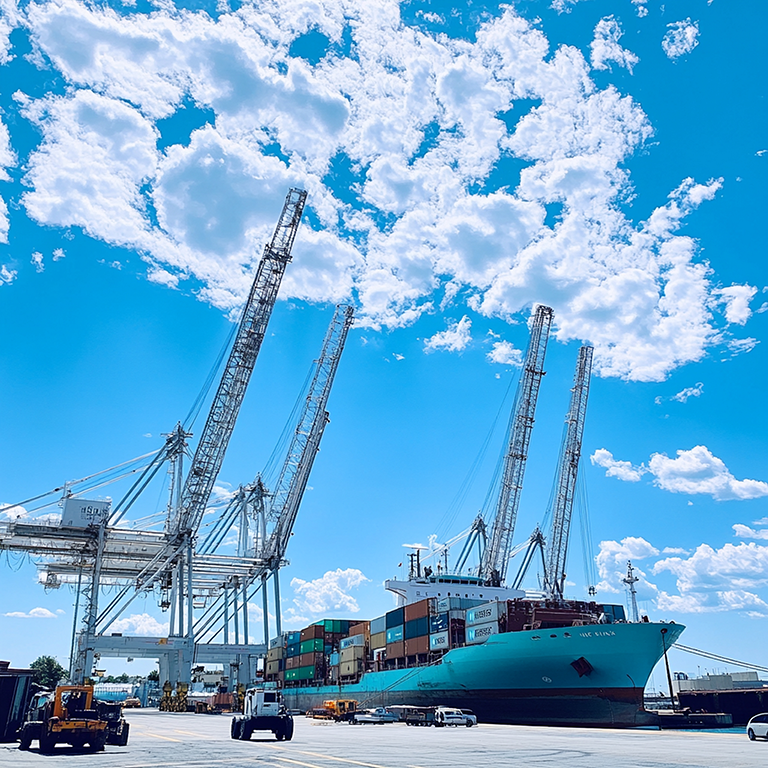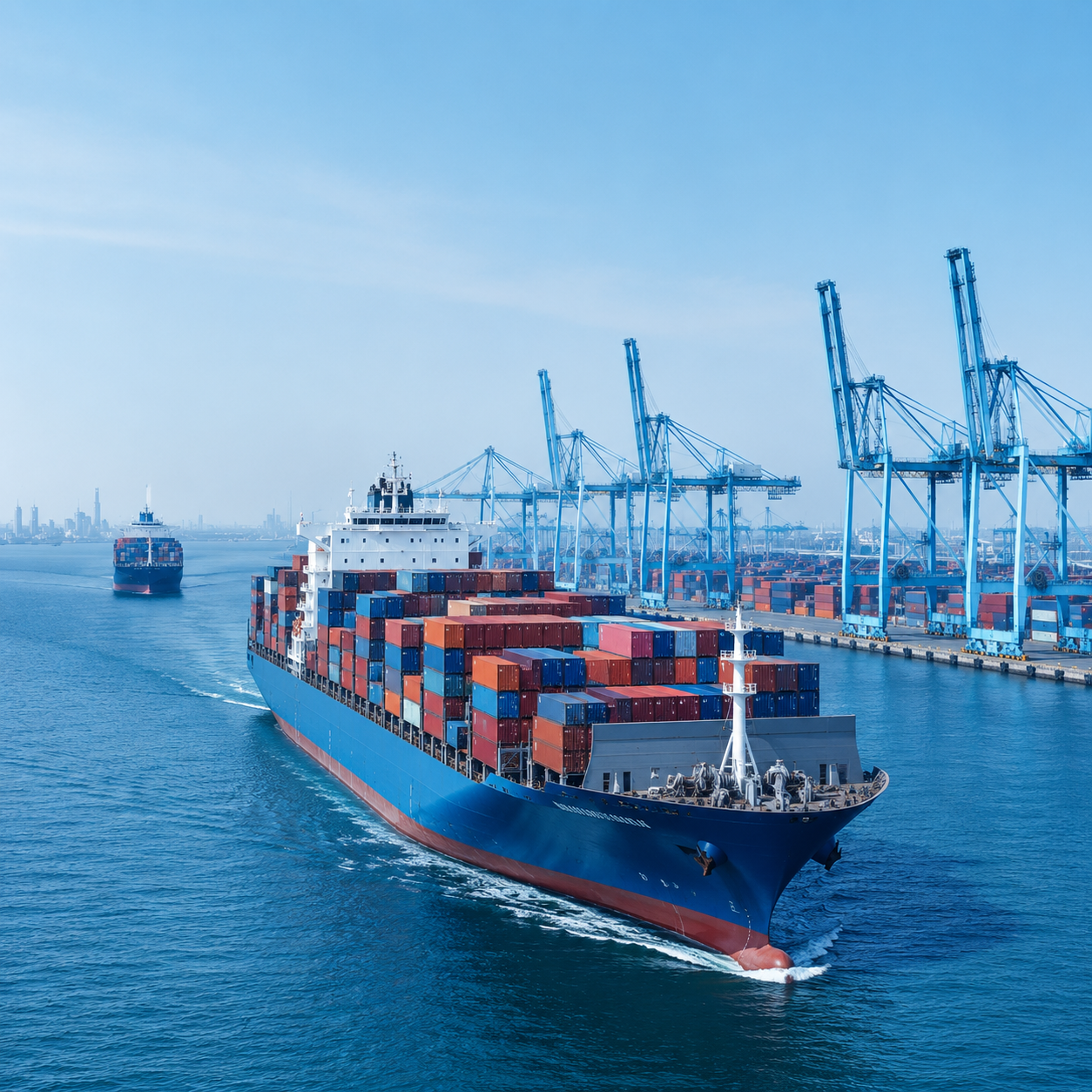




Global port congestion has reached an all-time high this week. More than 4.31 million TEU of shipping capacity is stuck in queues outside ports, more than at the height of the COVID-19 crisis in 2022. And whilst the backlog from four previous storms has not yet been cleared, Typhoon Saudel is heading for the Chinese coast.
According to market analyst Linerlytica, the volume of ships stuck in queues exceeds the previous record of 4 million TEU set during the post-pandemic surge in cargo. Globally, only 60 to 65 per cent of container ships are arriving on schedule at their planned ports. More than one in three ships is running five to seven days behind schedule. For importers planning for the fourth quarter and Golden Week, this is the worst combination of circumstances in four years.
Typhoon Saudel exacerbates port congestion in China
The peak in congestion is not the result of a single storm, but of a cluster of storms. Typhoons Bavi, Noul, Dolphin and Narra struck the Chinese east coast over a six-week period. Each storm forced ships to drop anchor rather than unload. The effect is cumulative: a typhoon does not clear the queue, but adds to it. When Typhoon Dolphin made landfall on the Zhejiang coast on 9 August, the terminals at Shanghai and Ningbo were at a standstill for three days. Before operations had returned to normal, Narra was already disrupting feeder services in Guangdong.
Data from Portcast this week showed 139 ships queuing for Shanghai and 77 for Ningbo – levels unprecedented in 2025 and 2026. At Shanghai’s Yangshan terminals, waiting times are running to five to six days for Gemini services and seven to eight days for other shipping lines. For Shanghai alone, over 1.5 million TEU of capacity is currently at anchor. North Asia as a whole accounts for approximately 2.2 million TEU, roughly half the global record.
Typhoon Saudel, the eighteenth named typhoon of 2026, is expected to make landfall between Fujian and Zhejiang between Thursday night and Friday morning. Around 11,000 ships had already sought shelter in Fujian ports on Wednesday. Freight forwarders are warning of disruption in Xiamen, Fuzhou, Ningbo and possibly Shanghai. Anyone expecting shipments from this region would be well advised to actively monitor arrival times, for example via the TOP platform with its real-time alerts.
El Niño: one climatic cause, two bottlenecks
The wave of typhoons in Asia and the water shortage in the Panama Canal may appear to be two separate problems. They are not. Both are manifestations of the same physical cause: the 2026 El Niño. Unusually warm seawater in the equatorial Pacific supplies extra thermal energy to typhoons in the western Pacific whilst simultaneously weakening the Walker circulation, the air current that drives rainfall over Central America.
Less rain means less fresh water in Gatun Lake, the water supply that feeds the Panama Canal’s lock system. The US climate centre, NOAA, estimates an 81 per cent chance that this El Niño will reach the ‘very strong’ classification by the end of 2026. For supply chain managers, this shared cause is crucial: the two bottlenecks cannot be resolved independently of one another. A temporary improvement in the situation at Gatun Lake does not reduce the frequency of typhoons, and vice versa.
Panama Canal further reduces transit capacity in September
On 20 August, the Panama Canal Authority (ACP) announced a further reduction in daily transit capacity in advisory notice ADV-29-2026. From bookings for 4 September onwards, the Neopanamax locks will offer nine slots per day and the Panamax locks 25, totalling 34 daily transits. From booking dates on or after 15 September, the total will fall to 32 transits per day. The reason: rainfall in the catchment area remains below normal, despite it being the rainy season.
There is also some slightly positive news. The ACP has postponed new draught restrictions: the 48.0-foot limit has been pushed back from 26 August to 2 September, and the 47.5-foot limit from 3 September to 1 October. As a result, vessels will be able to carry slightly more cargo per transit in the short term. Fully laden container ships with the highest TEU capacity are given priority in slot allocation, and only a confirmed booking guarantees a transit date. Without a slot, waiting times can run to ten days or more.
The market is already pricing in this scarcity. According to Drewry, the difference between the US east and west coasts is $2,705 per 40-foot container: Shanghai–New York is quoted at $9,507, whilst Shanghai–Los Angeles is $6,802. Cargo bound for the east coast without a canal slot must sail round the Cape of Good Hope, adding ten to fourteen days to the transit time.
How much capacity is actually lacking?
The record figure of 4.31 million TEU needs to be put into context. The global fleet has grown from 25.3 million TEU in 2022 to 34.4 million TEU today. The congested capacity therefore accounts for 12.6 per cent of the fleet, compared with 15.7 per cent at the height of the Covid-19 pandemic. In relative terms, therefore, congestion is lower, but in absolute terms it is higher. This makes little difference to freight rates, as the buffer has disappeared: of the more than 5,400 active container ships, only 55 are idle, according to Linerlytica – that is, 0.5 per cent of the fleet.
In addition, Sea-Intelligence estimates that delays are currently removing approximately 1.7 million TEU of effective capacity from the market, on top of the vessels currently laid up. Taken together, the market is functioning as if six to eight per cent of the global fleet did not exist. In 2022, shipping companies were still able to deploy underutilised vessels to absorb shocks; that reserve simply does not exist now.
Maersk raises profit forecast due to congestion
The freight data tells one story; Maersk’s figures tell the same story in hard currency. On 13 August, the world’s second-largest container shipping company reported quarterly revenue of $15.8 billion, 20 per cent more than a year earlier, and raised its full-year 2026 EBITDA forecast to between $10.5 billion and $12.5 billion. That is more than double the midpoint of the original forecast from February.
CEO Vincent Clerc’s statement is striking. It is not the conflict in the Middle East, but port congestion and network bottlenecks that are driving the results. Moreover, he says the bottleneck is shifting from the ships to the land side: cranes, terminals, railways and roads. This means that even a ceasefire will not immediately resolve the congestion, as infrastructure is not rebuilt through diplomacy. Hapag-Lloyd has also raised its forecast for 2026, citing strong demand and robust freight rates.
Rotterdam and European ports are also feeling the pressure
The disruption is not limited to Asia. Ports in the Benelux and Germany are facing arrival delays of up to a week, partly because ships are departing late from Asia and partly due to low water levels on the Rhine, which are affecting inland waterway connections. A ship that departs from Shanghai three days late arrives in Rotterdam three days late, and the knock-on effects extend right into the hinterland.
Durban in South Africa is struggling with persistent congestion caused by outdated equipment and infrastructure, rather than weather or geopolitical factors. Africa accounts for around nine per cent of global congestion. On the Indian subcontinent, the spot rate from North Asia to Nhava Sheva broke through the $10,000 mark for the first time this year in August, reaching approximately $10,700 per 40-foot container. Further background on rate developments can be found on the sea freight rates page.
What importers and exporters should do now
Book well in advance and ensure the booking is confirmed. With nine Neopanamax slots per day from 4 September, competition for east coast routes will be fierce. Anyone who does not secure a confirmed canal slot must factor in the route via the Cape of Good Hope and the associated ten to fourteen days’ delay now, rather than waiting until a diversion becomes necessary. Request multiple options in good time via a quotation enquiry and take into account surcharges and validity periods.
Build in stock buffers for critical items in the fourth quarter. With only 60 to 65 per cent of ships currently arriving on schedule, planning to the stated arrival date is planning for failure. A buffer of five to seven days is the minimum for cargo with a deadline around Golden Week or the festive season. For promotional items, seasonal goods and cold-chain products, express transport can act as a safety net, whilst cargo insurance covers the risks of a longer journey.
Actively monitor blank sailings. According to Drewry, 49 cancelled sailings have been announced on the major east-west routes for weeks 35 to 39 inclusive. A blank sailing means that cargo is carried over to the next sailing or has to wait longer. Those operating under index-linked contracts therefore face a rate risk on their next booking. Also check agreements regarding Incoterms, cut-off times and container handling, and read more about smart importing in volatile markets.
Digitalisation makes all the difference in this market. Real-time ETAs, automatic alerts and API integrations ensure you can react faster than the market. TOP utilises smart logistics for this purpose and collaborates with HEF Digital on AI, SEO, marketing and web development.
Key figures and sources at a glance
Global congestion: 4.31 million TEU backed up (Linerlytica), compared with the record of 4 million TEU in 2022. Proportion of the fleet: 12.6 per cent currently versus 15.7 per cent in 2022, with fleet growth from 25.3 to 34.4 million TEU. Idle capacity: 55 out of over 5,400 vessels (0.5 per cent). Effective loss due to delays: approximately 1.7 million TEU (Sea-Intelligence). Schedule reliability: 60 to 65 per cent. Queue at Shanghai: 139 vessels; Ningbo: 77 (Portcast). Drewry World Container Index as at 20 August: $4,526 per 40-foot container; Shanghai–New York $9,507; Shanghai–Los Angeles $6,802, both up 9 per cent week-on-week. Panama Canal as at 4 September: 34 daily transits; as at 15 September: 32 (ACP, ADV-29-2026). Probability of a ‘very strong’ El Niño in late 2026: 81 per cent (NOAA CPC).
Frequently asked questions about port congestion
Why is port congestion breaking the 2022 record even though the fleet is larger?
Because several disruptions are occurring simultaneously: a cluster of typhoons in China, water shortages in the Panama Canal, and congestion in Europe and Africa. In absolute terms, with 4.31 million TEU, there is more cargo on hold than ever before; in relative terms, the proportion (12.6 per cent) is lower than in 2022 (15.7 per cent). The decisive factor for freight rates is the lack of spare capacity: only 0.5 per cent of the fleet is idle.
How does El Niño cause both the typhoons and the drought in the Panama Canal region?
Warm seawater in the equatorial Pacific supplies typhoons in the western Pacific with extra energy and, at the same time, weakens the Walker circulation, resulting in less rainfall over the Gatun Lake catchment area. A single climatic event thus affects two shipping corridors simultaneously.
What changes will take place at the Panama Canal in September?
From 4 September, daily transits will fall to 34 (9 Neopanamax and 25 Panamax) and from 15 September to 32. The draught restrictions of 48.0 and 47.5 feet have been postponed to 2 September and 1 October respectively. Only a confirmed booking guarantees a transit date.
When will container rates fall again?
For that to happen, Typhoon Saudel must pass without causing major damage, the queues at Shanghai and Ningbo must be cleared, and no new storm must follow. Maersk anticipates relief around Golden Week in October in the best-case scenario; in the worst-case scenario, the bottlenecks will persist until the end of the year. Furthermore, the draught restriction at the Panama Canal is not weather-dependent and will therefore remain in place.
…a typhoon does not clear the queue for a port, but actually adds to it? Ships taking shelter at anchor simply add to the existing backlog. If storms follow one another in quick succession – as is currently the case with Bavi, Noul, Dolphin, Narra and Saudel – a port never gets the chance to recover, and congestion builds up week after week.