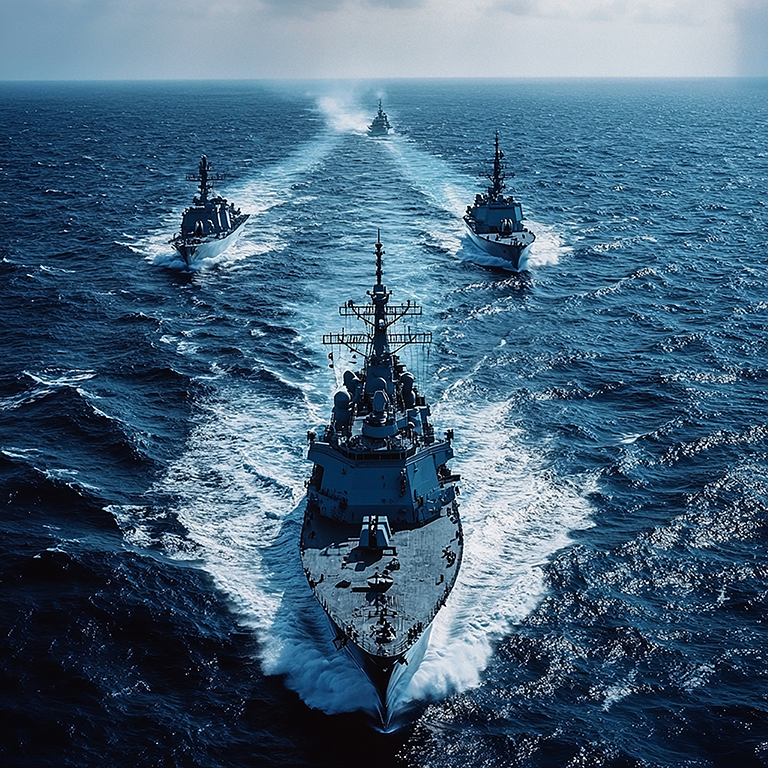




The US Department of Justice is taking serious steps to re-establish prize courts. This was reported by *Nieuwsblad Transport* on 27 August 2026. These special courts are intended to enable the US government to seize Iranian oil tankers and other vessels and retain their cargo as spoils of war.
It is no coincidence that *Nieuwsblad Transport* ran the headline stating that Donald Trump wants to “follow in the footsteps of Piet Hein”. The capture of enemy ships and their cargoes, with a court subsequently legitimising the haul, was standard practice in naval warfare for centuries. The Dutch capture of the Spanish Silver Fleet in 1628 is the best-known example of this. It is remarkable that Washington now wishes to dust off this instrument: according to Encyclopaedia Britannica, the US has not operated a prize court since 1899.
What is a court of prize?
A prize court is a national court that assesses whether the seizure of a ship or its cargo at sea was lawful. In times of war, private enemy vessels and neutral merchant ships carrying contraband — prohibited war materials — may be detained. Ownership does not automatically pass to the state that detains the ship. According to Britannica, a prize court of that state must first formally declare the ship and its cargo to be lawful ‘prize’.
The court assesses this in accordance with international law. Wikipedia explains that such a court may also order the return of a ship, for example if it was sailing under the flag of a neutral country and the seizure proves to be unlawful. It is therefore not a free pass to seize whatever passes by, but a legal framework governing privateering and confiscation.
The Dutch history: from the Watergeuzen to the admiralties
The Netherlands knows this world like no other. Historian Marjolein 't Hart describes on Historiek how, in the early years of the Eighty Years’ War, the Watergeuzen were more like privateers than a regular navy. They could be effective, as in the capture of Brielle in 1572, but they also attacked Dutch ships and ports on their own initiative. In 1573, William of Orange therefore disbanded the Geuzen fleet and established an organised admiralty system with branches in Rotterdam and Amsterdam, amongst other places.
Remarkably, war and trade went hand in hand in the Republic. The admiralties collected customs duties, organised convoy services and even lent cannons to merchant ships. According to ’t Hart, the Eighty Years’ War was the only war in the sixteenth and seventeenth centuries that actually led to economic prosperity. The lesson from that period: organised protection of trade routes pays off, whilst unregulated privateering mainly causes damage.
Why prize courts disappeared
Prize courts were common from the seventeenth through to the nineteenth century. After that, they fell into disuse. Britannica cites two reasons: the unrestricted naval warfare of the twentieth century, in which merchant ships were simply destroyed rather than captured, and the American policy of claiming foreign ships in return for compensation rather than appropriating them as prize.
Incidentally, the legal framework still exists in the US. According to Wikipedia, US district courts have had exclusive jurisdiction over prize cases since 1956, but not a single case has been heard since then. The United Kingdom, too, has formally retained prize jurisdiction within the Admiralty Court. The instrument had therefore been dormant, but had never been abolished.
Is this still possible in the present day?
Some clarification is needed here, strictly separate from the facts set out above. Not everything from the past is wrong by definition: a prize court is, at its core, precisely an attempt to subject confiscation at sea to judicial review, rather than leaving it to arbitrary decision-making. That is the principle on which the instrument operated for three centuries.
At the same time, the world of 2026 is not that of 1628. As early as 1907, the international community attempted to establish an international prize court in The Hague; that convention was never ratified, meaning that each state remains its own judge. It is not clear from the source material how a re-established US prize court would relate to contemporary maritime law, to neutral flag states and to cargo interests outside the conflict. What is certain, however, is that this move comes at a time when the maritime risk landscape — from Hormuz to the Red Sea — is already highly volatile.
Implications for importers and exporters
For most Dutch shippers, there is no immediate threat: according to reports, the plan is aimed at Iranian oil tankers and associated shipping operations. Nevertheless, it is wise to review one’s own supply chain. Anyone using routes or shipping lines involved in trade subject to sanctions would be well advised to check their transport insurance cover: confiscation and war risk are by no means always included under standard terms and conditions.
In addition, documentation is becoming increasingly important. Should a vessel be detained, documents such as the bill of lading and the commercial invoice determine who owns the cargo and where it comes from. If you are unsure whether a destination, consignor or route poses an additional risk, you can contact TOP for tailored advice. Above all, the news highlights that geopolitics and sea freight are once again closely intertwined — and that those who have their affairs in order have the least to fear.
as early as 1907, a treaty was concluded in The Hague for an International Court of Arbitration, which was intended to elevate price disputes above the national level? The treaty was never ratified and the court was never established — as a result, price disputes have always remained a matter for national courts.