



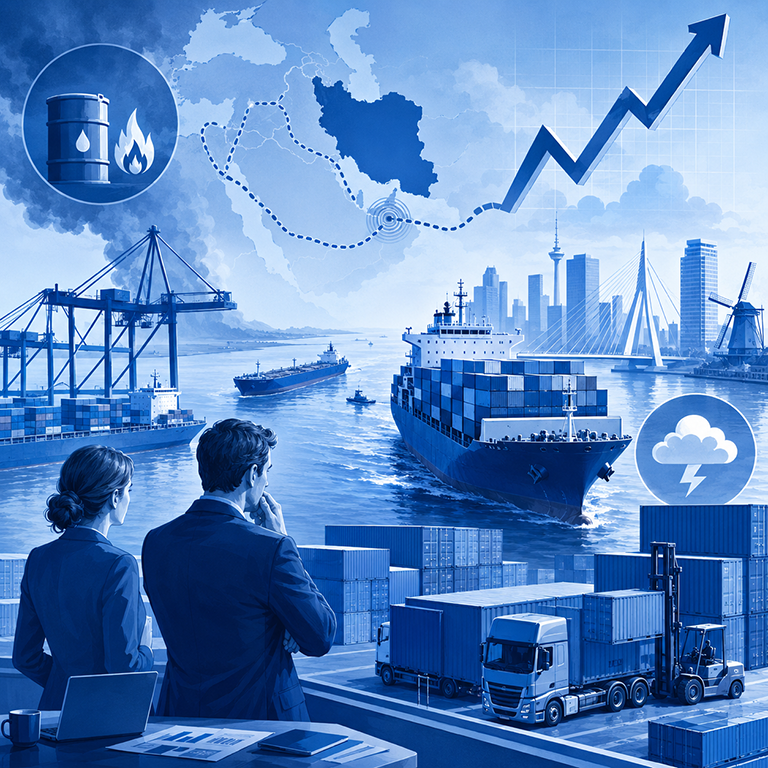
Dutch businesses are feeling the effects of the war between the United States and Iran in the Middle East. Rising fuel and energy prices, in particular, are putting pressure on companies.
This is evident from a survey conducted by the Chamber of Commerce among 530 entrepreneurs. Larger small and medium-sized enterprises, in particular, are experiencing difficulties as a result of the conflict. In addition to rising energy prices, entrepreneurs also cite higher purchase prices, rising transport costs, cash flow problems and uncertainty about future income.
Dutch business owners affected by rising costs
According to the Chamber of Commerce, 44 per cent of the entrepreneurs surveyed say they are being affected by sharply rising fuel and energy prices. These costs therefore represent the greatest concern for businesses affected by the war in the Middle East.
For businesses with international goods flows, such price rises can quickly have an impact on day-to-day operations. Higher fuel costs affect sea freight, air freight, road transport and distribution. Purchase prices may also rise when suppliers pass on additional costs or when raw materials and transport capacity become more expensive.
It is therefore important for Dutch businesses to look not only at the direct purchase price, but also at surcharges, delivery times, transport conditions and payment arrangements. Further information on current transport costs can be found on the pages about the diesel surcharge, sea freight and air freight.
Transport costs are rising due to uncertainty
The war between the United States and Iran is not only affecting energy prices. Transport costs are also rising as markets factor in higher risks, longer routes, more expensive fuel and potential disruptions on key trade corridors.
As a result, businesses that import or export goods may face changing quotations, shorter validity periods for rates and additional surcharges. This makes budgeting more difficult. Particularly when customers expect fixed selling prices, it is difficult to pass on sudden cost increases in full.
Delivery times may also become more uncertain. When shipping lines adjust routes, reallocate capacity or adopt a more cautious approach in high-risk areas, this can have consequences for planning and stock management. For businesses dealing with seasonal products, project-based deliveries or tight production schedules, this uncertainty can weigh heavily.
Cash flow under pressure for Dutch businesses
Some businesses are also reporting cash flow problems. This is to be expected when costs are rising faster than revenue. Companies often have to pay suppliers, hauliers, import duties, VAT and other costs first, whilst customers pay later.
This can be particularly challenging for importing businesses. They face higher purchase prices, more expensive logistics and potentially longer periods of pre-financing stock. When transport takes longer or containers are delayed, capital remains tied up for longer in goods that cannot yet be sold.
This makes clear agreements on Incoterms, payment terms and transport planning all the more important. Clear terms of delivery help businesses to better determine where risks, costs and responsibilities lie. Read more about Incoterms, importing and exporting.
Many companies have not yet taken any measures
It is striking that, according to the Chamber of Commerce, more than half of business owners have not yet taken any measures in response to the conflict. This may mean that companies are waiting to see how the situation develops, but it could also mean that they are unsure of the steps they can take.
One-fifth of SMEs say they are well prepared for future disruptions to international trade. At the same time, one-tenth indicate that they have made no preparations at all. This disparity shows that resilience within the business community varies greatly.
For Dutch businesses, preparation can involve a range of measures. These include alternative suppliers, more flexible delivery times, extra stock of critical products, fixed agreements with logistics partners, contingency plans for higher transport costs and closer monitoring of international developments.
Larger SMEs face the greatest disruption
According to the survey, larger small and medium-sized enterprises (SMEs) in particular are experiencing significant disruption. These companies often have more international procurement, larger transport volumes and more complex supply chains than smaller businesses. As a result, they are more vulnerable to disruptions in energy, logistics and raw materials.
At the same time, larger SMEs often have less bargaining power than multinationals. They cannot always pass on rising costs immediately, but they do have to deal with professional customers, fixed contracts and tight margins.
This makes logistical transparency crucial. Those who gain insight into rates, surcharges and potential delays at an earlier stage can make adjustments more quickly. TOP supports clients with international logistics, customs clearance and route selection. Read more about requesting rates and customs.
Looking ahead is becoming more important
The survey shows that international conflicts are quickly having an impact on Dutch businesses. Even entrepreneurs who do not do business directly with Iran or the United States can be affected by higher energy prices, more expensive transport and uncertainty amongst suppliers.
For business owners, therefore, it is increasingly about looking ahead. Not every risk can be prevented, but companies can ensure better information, clear agreements and greater flexibility within their supply chain.
TOP closely monitors developments relating to geopolitical tensions, transport costs and international trade routes. For clients, it remains important to adapt promptly when markets shift and costs change.
…fuel and energy costs are often the first to be reflected in logistics rates? After that, purchase prices, pre-financing, stock costs and delivery times may also come under pressure.