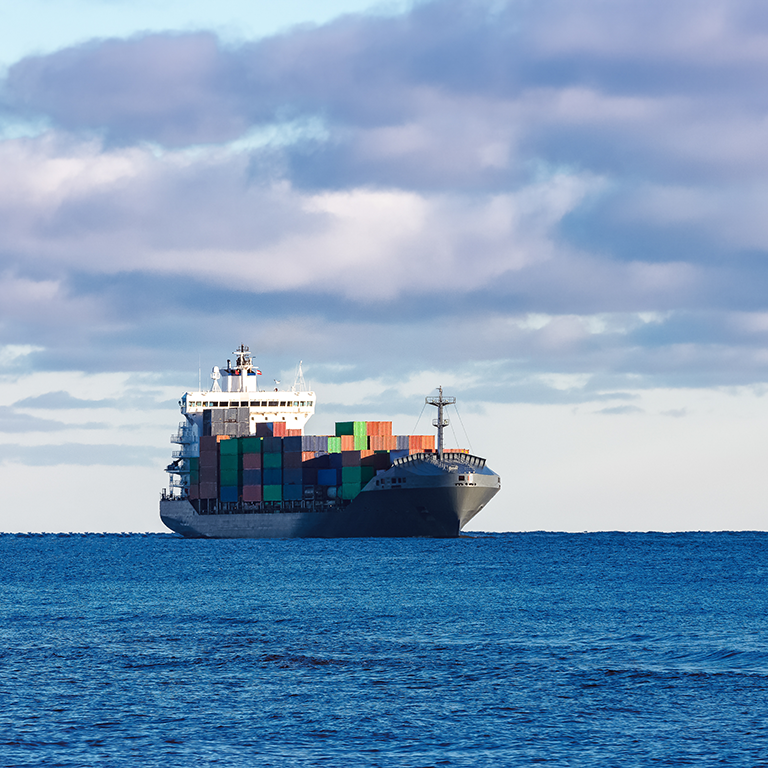




Maersk is adjusting several services in response to the escalating conflict. The Danish container shipping company is temporarily suspending its feeder service to the Ukrainian port of Chornomorsk and restricting the use of the Saudi land bridge via Jeddah.
The measures affect two sensitive regions simultaneously: Ukraine and the Middle East. In both cases, Maersk is opting for alternative routes to better protect its staff, vessels and cargo.
Maersk suspends feeder service to Chornomorsk
Maersk is temporarily suspending its own feeder service to Chornomorsk Fishing Port, south of Odessa. The container service between Port Said in Egypt and Chornomorsk was launched in October 2024, but due to the recent escalation around Odessa, the service is being suspended until further notice.
The decision follows a severe attack near Odessa. Russia fired cruise missiles at the Turkish bulk carrier Golden Leo, which was loaded with grain. Ten people were killed: nine crew members from India and Syria, and a Ukrainian pilot.
The container ship Medkon Mira, which was due to call at Chornomorsk, is now being diverted to the Romanian port of Constanța. The containers will be unloaded there, after which the cargo can still be transported to Ukraine via inland transport. Further information on international sea freight can be found on the sea freight page.
Ukraine-bound cargo diverted to Constanța
Constanța is thus once again becoming more important as an alternative port for Ukraine-related cargo. Since the war began, the Romanian port has already been playing a greater role in the import and export of goods that would otherwise pass through Ukrainian ports.
For shippers, a diversion to Constanța means additional links in the supply chain. Containers must be rescheduled, local handling must be arranged, and onward transport to Ukraine requires capacity, documentation and security coordination.
This makes logistics less predictable. Furthermore, the final destination may be reached later than originally planned. For companies with production schedules, contractual delivery dates or seasonal goods, this poses a significant risk.
Maersk scales back land bridge via Jeddah
Maersk is also taking action in the Middle East. For the time being, the shipping company is making less use of the so-called land bridge via the Saudi port of Jeddah for freight bound for neighbouring countries in the Persian Gulf.
This overland route was specifically deployed as an alternative during blockades and tensions surrounding the Strait of Hormuz. Cargo could be brought in via the Red Sea port of Jeddah and then transported overland to destinations in the Gulf.
Due to the new Houthi threat to Saudi Red Sea ports, this solution is now being scaled back to some extent. Maersk will, however, continue to sail to Jeddah and still use the land bridge for certain Saudi import and export cargo, including freight bound for Riyadh and Dammam.
Houthi threat affects alternative routes
The Houthis have announced a maritime blockade of Saudi ports. This is once again putting pressure on routes that, in recent months, had been used as alternatives for cargo that was more difficult to transport via the Persian Gulf due to tensions surrounding the Strait of Hormuz.
For Maersk, this means the route puzzle is changing once again. What previously seemed like a safe diversion may now come under pressure due to a new threat. In its operational updates, the shipping company refers to proactive measures to protect personnel, vessels and cargo.
For shippers, this is a clear signal. In turbulent regions, routes, ports and land bridges can change rapidly. This requires up-to-date information, flexible planning and clear agreements on costs and responsibilities. Read more about cross-trades and multimodal transport.
Sharjah, Salalah and Khor Fakkan to play a greater role
For transhipment cargo bound for Kuwait, Iraq, Qatar, Bahrain and the United Arab Emirates, Maersk is, for the time being, focusing more heavily on a different land bridge. This route runs between Sharjah, on the Persian Gulf, and the seaports of Salalah in Oman and Khor Fakkan in the United Arab Emirates.
Salalah and Khor Fakkan are situated on the Gulf of Oman and are therefore strategically attractive should routes via the Strait of Hormuz or the Red Sea become more uncertain. Through these ports, cargo can be redistributed, although implementation remains dependent on local capacity, security and the availability of transport.
This shift highlights just how important regional alternatives have become. The choice of port is no longer solely a matter of cost or transit time, but also of geopolitical risk and operational resilience.
Emergency Freight Surcharge for Gulf Ports
Due to the changing situation, Maersk is introducing an Emergency Freight Surcharge for cargo to and from ports in Iraq, Kuwait, Saudi Arabia, Bahrain, Qatar, the United Arab Emirates and Oman, with the exception of Salalah.
The charges amount to $1,800 per TEU, $3,000 per 40-foot container and $3,800 for reefers, special containers and dangerous goods. For Maersk cargo that, despite the risks, still transits the Strait of Hormuz, an additional surcharge of $1,000 per container applies.
For importers and exporters, such surcharges can have a significant impact on the total cost. The base rate therefore does not tell the whole story. Additional costs for security, detours, storage, insurance and onward transport can make a shipment considerably more expensive.
Consequences for importers and exporters
For companies trading with Ukraine, Saudi Arabia, the Gulf region or neighbouring markets, this means that route certainty is less assured. A booked route may be adjusted if security situations change.
Costs can also rise rapidly due to surcharges and alternative handling arrangements. Companies would be well advised to check quotations for validity, included costs, final destination, any overland routes and the terms and conditions in the event of a change to the route or port of discharge.
TOP is closely monitoring developments concerning Maersk, Ukraine, the Red Sea, the Strait of Hormuz and alternative land bridges. It remains important for customers to discuss transport options in good time and to take into account changed routes, surcharges and longer transit times. Further practical information can be found on the pages about importing, exporting and requesting rates.
The violence of war makes logistics less predictable
Maersk’s actions demonstrate how quickly the violence of war can affect logistics networks. A single attack, threat of a blockade or security alert can be enough to alter routes, suspend services or introduce surcharges.
This creates a more complex playing field for global trade. Shipping lines must not only take into account capacity, fuel and port planning, but also missile attacks, drones, blockades, sanctions and political tensions.
For shippers, collaboration with logistics partners is becoming increasingly important. Alternatives must be assessed quickly, documentation must be accurate, and communication regarding changes must be clear. In turbulent markets, flexibility is often just as important as price.
…land bridges are often used in logistical crisis situations to ensure that sea freight still reaches its final destination via an alternative port? They offer flexibility, but can result in additional costs, delays and documentation requirements.
Related news

Would you like to receive our newsletter?
Stay up to date with Maersk, sea freight, Ukraine, land bridges and international logistics developments. Sign up now: